
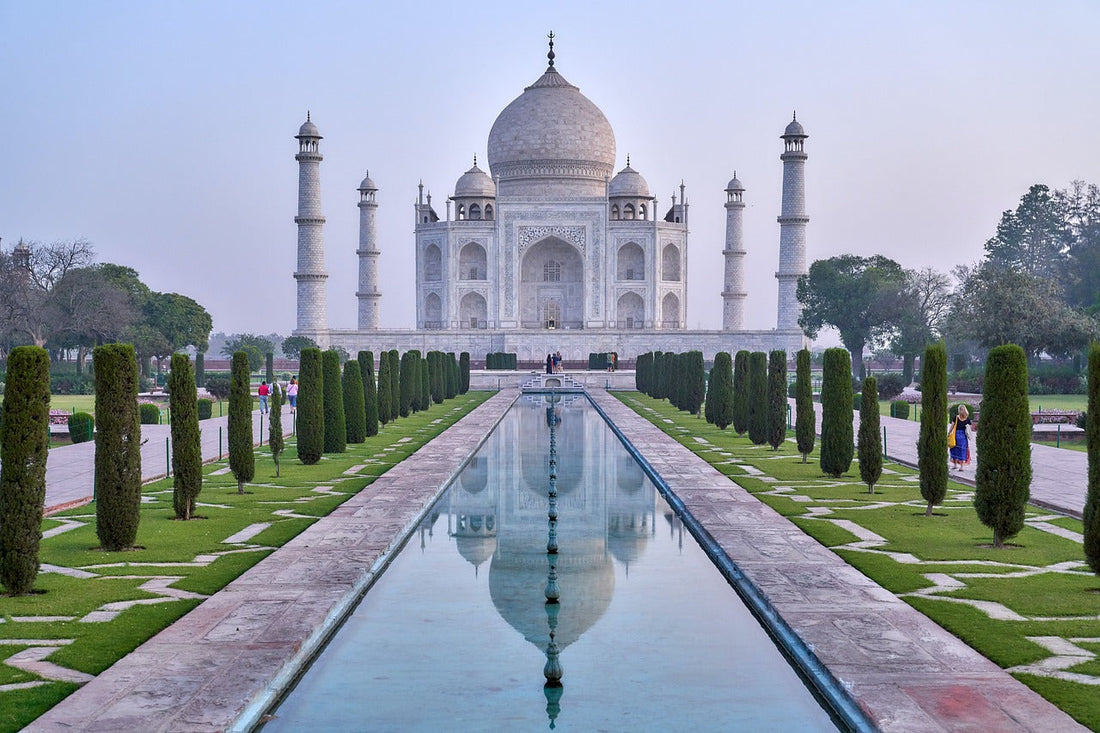
The Taj Mahal – a love poem in marble
Share
When we think of the Taj Mahal today, we picture the dazzling white mausoleum rising on the banks of the Yamuna River in Agra. It is considered one of the most beautiful buildings in the world – a symbol of love, grief, and the longing for eternity. But behind this famous facade lies a rich history full of fascinating details that not everyone knows.
A monument to love
The Mughal emperor Shah Jahan commissioned the Taj Mahal in the 17th century as a memorial to his great love Mumtaz Mahal, who died giving birth to their 14th child. Instead of building a traditional tomb, Shah Jahan wanted to create an "earthly image of paradise"—and thus this mausoleum was created, which continues to captivate people from all over the world.
Architecture as symbolism
The entire ensemble is a finely composed Gesamtkunstwerk (total work of art):
- Perfect symmetry represents harmony and order.
- The garden with its four canals symbolizes the rivers of paradise from the Koran.
- Even the choice of white marble has meaning: purity, light and spirituality.
It is little known that the dome – which rises majestically above the burial chamber – is often referred to as an “onion dome” and was an architectural novelty in India at the time.
A planned black twin?
One of the most famous legends tells of Shah Jahan's plan to build a second Taj Mahal, made of black marble, for himself on the other side of the river, connected by a bridge. Historians disagree: some have evidence that such plans actually existed, while others consider it a romantic tale that only enhanced the myth surrounding the building.
Facts that not everyone knows
- Play of colors: Depending on the time of day and lighting conditions, the Taj Mahal changes its color – from delicate pink at dawn to radiant white at midday to golden at sunset.
- A masterpiece of craftsmanship: Over 20,000 workers and over 1,000 elephants were involved in transporting marble blocks and precious stones.
- Secret inlay work: Many of the floral patterns are made from semi-precious stones that seem to glow when light hits them.
- Protection during World War II: During World War II, the Taj Mahal was covered with bamboo scaffolding to camouflage it from air raids – a curious image that shows how valuable the building was even then.
The legacy
Ironically, after a power struggle with his son Aurangzeb, Shah Jahan could only see the Taj Mahal from afar. He spent his final years as a prisoner in the Red Fort of Agra, overlooking the tomb of his great love. After his death, he was buried next to Mumtaz Mahal – the only interruption to the Taj Mahal's perfect symmetry.
Conclusion
The Taj Mahal is far more than just a building: it is a cultural memory, a poetic monument, and a masterpiece of architecture. Its appeal lies not only in its beauty, but also in the stories, myths, and little secrets that surround it.